The Frozen Paradox: How Arctic Warming Sends a Cold Wave That Freezes America
Published: 26 January 2026
Eran Shchori
Climate leader at the 'Climate Reality Project' organization founded by Al Gore, former US Vice President. Former member of the Israeli Climate Forum
More than 200 million Americans are freezing this week in a brutal Arctic cold wave, with temperatures plunging dozens of degrees below zero. But here's the stunning paradox: global warming might actually be to blame. How is it possible that a warmer world is producing more extreme, colder winters? The answer lies in a dangerous dance of winds, 31 miles (50 km) above the North Pole.
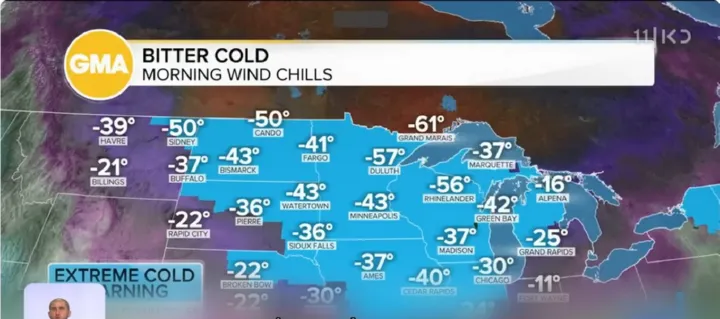
Chicago, minus 13 degrees Fahrenheit (-25°C). In Montana, the wind chill plummets to a staggering -40°F (-40°C), a dangerous level that can cause frostbite in just a few minutes. Even in Dallas, Texas, residents are waking up to a thin layer of ice on their cars. This weekend, more than 200 million Americans—roughly two-thirds of the country—are under extreme weather alerts. This isn't just "winter"; it's an aggressive invasion of frigid Arctic air plunging south and freezing everything in its path.
This story begins thousands of miles to the north, in the most unexpected of places. Ironically, this extreme cold snap is a symptom of a warming world. Welcome to the great paradox of climate change.
Extreme cold in North America due to Arctic storm | January 24, 2026 | Screenshot
What's Happening This Week? An Invasion from the Pole
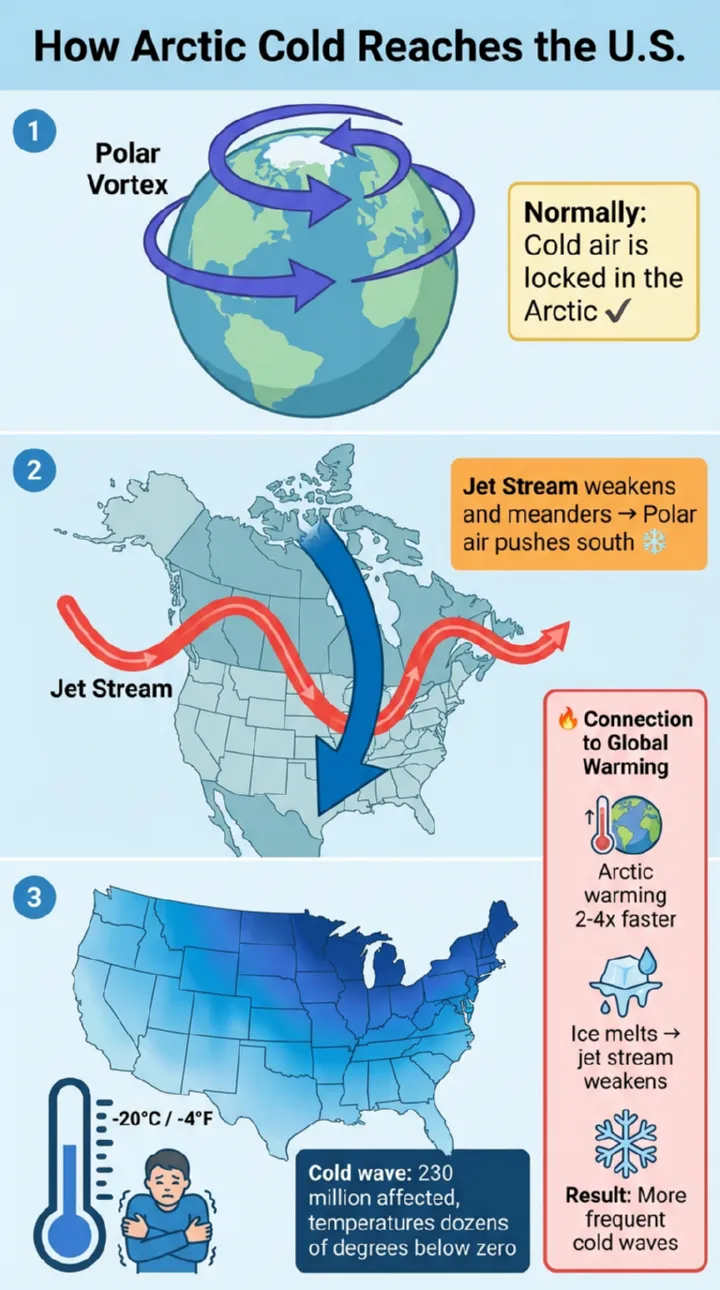
What the U.S. is experiencing right now isn't a normal storm. It's a meteorological event known as an "Arctic outbreak." Imagine someone opened the door to Earth's giant freezer—the North Pole—and all the frigid air spilled out. This air, normally "locked up" in the planet's northernmost regions, has broken through its natural boundaries and is flowing south, deep into the North American continent.
The result is a dramatic drop in temperatures, sometimes 25-35°F (15-20°C) below the seasonal average. Schools are closing, flights are canceled, and authorities are warning residents to stay indoors. It's an extreme event that challenges infrastructure and daily life, and it raises a pressing question: How is this happening, and why does it feel like it's happening more and more often?
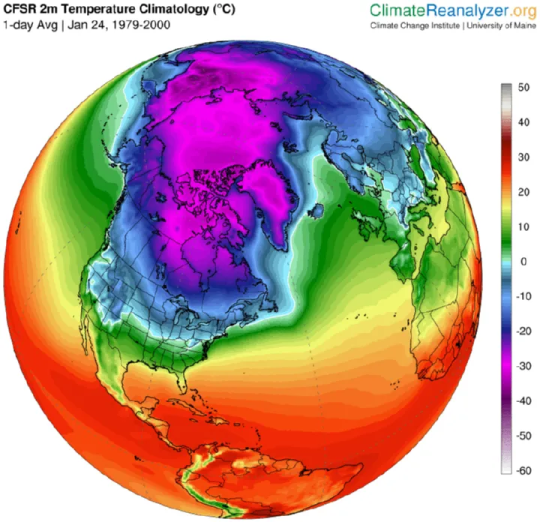
Temperatures Map
Weather map - average temperature 2 meters above the ground, January 24, 2026. The area in purple - a temperature of minus 30 Celsius
Image explained: In North America (USA and Canada): In some areas, mainly in the center and east of the continent, temperatures were as low as -41.1°C (or -42°F) below the historical average of 1979-2000. This is a direct result of the intrusion of Arctic air southward due to the disruption of the polar vortex.
In the Arctic and North Pole: In contrast to the intense cold on the continent, the Arctic itself recorded extreme positive (warm) anomalies. The data indicated temperatures that were more than 28°C higher than the 1979-2000 average. In extreme cases of sudden stratospheric warming, the anomaly in the polar region can reach even 34°C above average.
The data shows the dramatic contrast (paradox) noted in this post: while populated areas in the south are experiencing unprecedented cold (negative anomaly of (about 40 degrees), the Arctic region experienced unusual warmth (a positive anomaly of about 30 degrees). The "open door" of the Arctic refrigerator caused the cold air to escape south, leaving the "refrigerator" itself (the Arctic) much warmer than usual.
Why Is This Happening? Changes at the North Pole
To understand the mechanism, we need to look up into the sky, to an altitude of about 18 to 31 miles (30 to 50 kilometers). There, in the stratosphere, a spectacular phenomenon occurs every winter: the Polar Vortex.
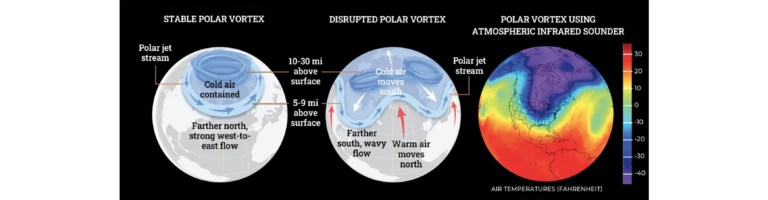
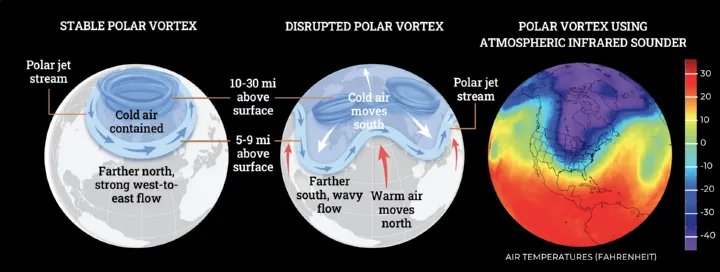
Don't let the name mislead you. The polar vortex is a natural and essential phenomenon. Picture it as a giant, stable spinning top of strong winds rotating over the North Pole. Its job is to act as a fence, a wall of wind, that keeps the coldest, densest air in the world contained in the Arctic region. As long as this spinning top is stable and strong, winters in the mid-latitudes (like in Europe and most of the U.S.) tend to be relatively mild.
But sometimes, this spinning top gets "knocked" around. Atmospheric energy waves rising from below can disrupt it, causing it to slow down, wobble, stretch, and even split in two. When the vortex weakens, the "fence" is breached.
This is where another player enters the game: the Jet Stream. It's a massive river of fast-moving winds at high altitudes, flowing from west to east and separating the cold air to the north from the warm air to the south. When the polar vortex is stable, it keeps the jet stream strong and flowing in a relatively straight path. But when the vortex is disrupted, the jet stream weakens and begins to meander like a snake. These deep meanders are the problem: one loop can pull warm air northward, while another opens a wide "door" for frigid Arctic air to plunge southward. That's exactly what's happening over North America right now.
Infographics: Polar Vortex (Stable and Disrupted) + Atmospheric Infrared.
Source: National
Oceanic and Atmospheric
The Surprising Connection: How Does Global Warming Fit In?
This is where we get to the heart of the paradox. How does a warming world produce such extreme cold snaps? The answer lies in the fact that the Earth is not warming evenly. The Arctic is warming two to four times faster than the rest of the planet, a phenomenon known as Arctic Amplification.
Why? Think of a white car versus a black car on a sunny day. Which one gets hotter? Bright, white sea ice reflects most of the sun's radiation back into space (like the white car). But as the ice melts, it exposes the dark ocean water beneath. This dark water absorbs the sun's heat (like the black car), accelerating the warming even further. It's a destructive positive feedback loop.
This accelerated warming in the Arctic reduces the temperature difference between the cold Arctic and the warmer regions to the south. And what drives the jet stream? Precisely this temperature difference! When the difference shrinks, the jet stream's "engine" weakens. A weaker jet stream is a wavier jet stream, one that is more prone to getting "stuck" in place for days on end. The result: more opportunities for long, powerful Arctic outbreaks, just like the one we're seeing now.
In other words, the warming Arctic doesn't eliminate the cold; it just "unleashes" it from its Arctic prison and pushes it down to where we live.
How Arctic Cold Reaches the U.S
How Arctic Cold Reaches the U.S
Video: What is a Polar Vortex
Is This Really Happening More Often? The Changing Nature of Winter
The logical question is whether these cold snaps have become more common. The answer is complex. On average, our winters are indeed getting warmer, with fewer cold days overall. However, studies suggest that the *character* of winter weather is changing. We're experiencing less "moderate cold" and more "stuck" extreme events—whether it's an unusual winter heatwave or a deep Arctic freeze that stays with us for a week or more.
Events like the "polar vortex" outbreak of 2014, the 2019 cold wave, and the deadly 2021 Texas freeze are all examples of this pattern. Scientists are still studying the full extent of this connection, but the accumulating evidence points to accelerated Arctic warming playing a key role in disrupting atmospheric stability.
Conclusion: The Climate Is a Complex System
The cold wave of January 2026 is a powerful reminder that global warming is not a simple, linear process. It’s not a warm blanket being spread evenly across the globe. It's a profound disruption of a complex, interconnected system. A dramatic change in one area—the Arctic—can trigger surprising and extreme effects thousands of miles away.
The Frozen Paradox teaches us that the fight against climate change isn't just about preventing heatwaves; it's about preserving the stability of the entire system—the system that allows us to live in a world with relatively predictable and moderate weather. The next time you're shivering through an extreme cold snap, remember that the story begins in an ever-warming Arctic.
President Donald Trump's Denial of Global Warming
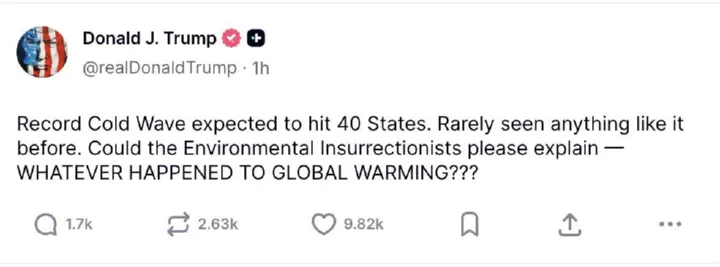
President Donald Trump posted a warning on his social media account, Truth Social, regarding the approaching Arctic storm, and in the same tweet, he questioned the narrative of the climate crisis.
הפוסט נכתב ואוייר בסיוע כלי AI
Video footage from the Arctic storm in the USA
CNN - Massive winter storm: About a million without power in the US